Thursday, 28 August 2014

Nine More Things You Didn't Know About the Church


#1- During the days of the Black Death, an extreme sect of Christians known as the Flagellant Brothers roamed from village to village, dragging crosses and whipping themselves for penance.

#2 - Pope Gregory I decreed that his monks would live communally, sharing all that they had. Sounds great, right? Actually, Gregory took it to an unholy extreme. When he discovered that one of the brothers had hidden three gold coins, he ordered the other monks to ostracize him. Even when the offending man was on his death bed, he was forbidden to have visitors. What was the purpose of this cruelty, you might ask? Gregory hoped that it might make him repent, and thereby save him from eternity in Hell. After the brother died, he was buried in a dung heap to set an example for the other monks.

#3 - According to legend, God gave Saint Christopher a dog head to ward off the unwanted attention of the local ladies.

#4 - The Hand of Saint Theresa was treasured as a relic by the Spanish tyrant, Francisco Franko. He was rarely seen without it, and even slept with the Hand under his pillow.

#4 - Martin Luther had a diet of Worms. Heh. Bad pun, I know.

#6 - There is some dispute over which disciple reached Jesus' tomb first. John claims that he outran Peter, but Peter says that they arrived at the same time. Sounds like there was some competition going on.

#7 - In the days before the printing press, monks had to create copies of the Bible by hand. They worked under strict silence but--much like modern schoolboys--found ways around the rules by doodling in the margins. One man drew a bunch of monkeys harassing a scribe. Another scribbled a merman getting shot with an arrow. Still others griped about their working conditions: "Oh my hand," "I am very cold," "Writing is excessive drudgery. It crooks your back, it dims your sight, it twists your stomach and your sides."

#8 - The world "cathedral" means "the church that contains the bishop's throne."

#9 - Several Saints--such as Saint Joseph of Cupertino and Saint Martin de Porres--were able to fly and be in two places at once. While it sounds ridiculous at first, bear in mind that God's done stranger things. Remember that talking donkey? In light of that, I actually don't think flying Saints is such a stretch.

Tuesday, 19 August 2014

Outstanding People in History - Ignaz Semmelweis


19th century medicine was untrustworthy at best. Doctors came at you with leaches instead of a stethoscope, and sickness flitted from person to person with devastating results. Nobody knew where it came from. The effect of bacteria wouldn’t be discovered until the 1870s. Still, doctors endeavored to save their patients with what little information they had.
One of these doctors was Ignaz Semmelweis, who worked in a Hungarian maternity clinic during 1844. At the time, most women preferred to give birth at home. Those who were forced to seek hospitalization faced staggering mortality rates. Childbed fever claimed the lives of 25-30 percent, and worse, nobody understood what caused it. Maybe it was poor ventilation? Or maybe a Death Angel was prowling the clinic. Semmelweis determined to discover the cause and, if possible, prevent it.
One of the first things he did was compare his clinic with another that had a lower mortality rate. Both were overcrowded. Both had identical ventilation. The only difference was that Semmelweis’ clinic was next door to a morgue. Doctors were constantly going back and forth between autopsies and checkups, but surely that didn’t mean anything.
Turns out, it did.
Bacteria from the cadavers was being transported from the staff to the patients. Of course, Semmelweis hadn’t a clue. Germs wouldn’t be discovered for several decades, and the idea sounded like madness. He only realized the truth after a friend died from a wound incurred during the examination of an ill woman. The similarities between the two cases led him to the conclusion that something from the morgue was spreading to the patients.
Semmelweis took immediate action. As the head of the maternity ward, he declared that the staff must wash their hands on a regular basis. To everyone’s surprise, mortality rates plummeted. In March and August of 1848, childbed fever claimed no casualties.
At first this new practice was eagerly received--but then political revolution swept over Europe. Semmelweis sided with the unpopular party and was dismissed from the hospital. Doctors stopped washing their hands as soon as he was gone, ridiculed his theories, and ignored the rising death rate.
Ousted from the clinic, Semmelweis struggled to spread the word about his discoveries. He gave lectures at Universities, wrote letters to other scientists and even published a book--but it was all in vain. The medical community was unwilling to set aside their old ideas about the spread of disease, and countless patients paid the price.

As the years went by, Semmelweis began to show signs of Alzheimer’s disease. He was committed to an insane asylum and died two weeks later, having possibly been beaten by the guards. The significance of his discoveries was only realized years after his death. Younger doctors such as Louis Pasteur and Joseph Lister carried on his work, successfully introducing antisepsis to the medical community.


Tuesday, 12 August 2014

Snapshots of the Great Depression


Dust storms

In addition to drought and dust-storms, a plague of jackrabbits came to devour the crops.


Two teenagers hitchhiking on a train.

A man eating Christmas dinner with his children.


Thursday, 7 August 2014

Carry Nation

Carry Nation with her hatchet.


Alcohol has always been a controversial topic. It was no different in the 1900s, when the Women’s Christian Temperance Union began pushing for complete and total abstinence from liquor. A drinking epidemic had seized the country, and nationwide Prohibition seemed to be the best answer. If the menfolk weren’t strong enough to put the bottle down, the womenfolk would yank it out of their hands.
The WCTU worked mostly through hymns and prayer rallies. But one woman, Carry Nation, took a more radical approach. Frustrated by the lack of response to prohibition laws in Kansas, she collected a pile of rocks and started smashing saloons in Kiowa. As the saloons were illegal in the first place, she was not arrested.
Carry Nation claimed to have been divinely appointed for the task of destroying alcoholism in a vision, which she recorded in the following quote:

"GO TO KIOWA," and my hands were lifted and thrown down and the words, "I'LL STAND BY YOU." The words, "Go to Kiowa," were spoken in a murmuring, musical tone, low and soft, but "I'll stand by you," was very clear, positive and emphatic. I was impressed with a great inspiration, the interpretation was very plain, it was this: "Take something in your hands, and throw at these places in Kiowa and smash them."

After destroying the saloons in Kiowa, Nation hopped on a train, traveled to Wichita, and laid waste to another barroom. Bang! Smash! Thud! Glass scattered across the floor. Paintings were bashed under her club. The customers fled, and finally a policeman arrived on the scene.
“Madam,” he said, “I must arrest you for defacing property.”
“Defacing?” Carry screamed. “I am destroying!”
Over the next ten years she went on to be arrested thirty times, becoming a household name in the process. The WCTU awarded her a medal for bravery. Two newspapers about her movement were kept in circulation. Carry upgraded her homemade club to a hatchet, which went on to become her trademark.
To be honest, I’m not quite sure what I think of Carry. On one hand, she seems sincerely devoted to the prohibition cause--but what’s worse? Drinking or murdering? She was going hatchet-crazy in a room packed with inebriated people. Somebody could’ve been killed. Besides, not everyone who drinks is a drunkard. Take Jesus for example. He turned water into wine. He drank wine himself. He told his disciples to drink. Wine even came out of his side when the soldiers stabbed him. I don’t think Jesus would tell Carry to spearhead a complete-and-total-abstinence movement.
Nation’s saloon-smashing crusade chugged ahead for several years, but lost steam as she grew older. Instead of ransacking bars, she started touring the country to sell commemorative hatchets, milking her dwindling fame. Eventually, she became to frail to even do that, and retired in Arkansas. Her daughter (who happened to be married to a saloon owner) provided financial support during her last days, and Carry Nation went to be with the God she loved so much on June 2, 1911. Just a few years before country-wide Prohibition came into affect.

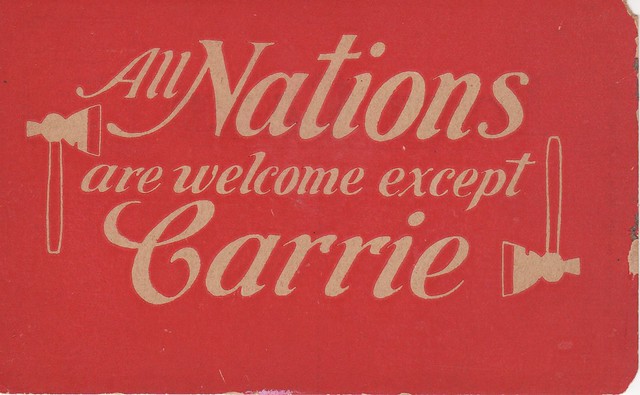
An anti-Carry sign found hanging in saloons.

Sorry I haven't posted in awhile--I've had a nasty case of procrastination--but now I plan on posting something every Tuesday. Please help me stick to that goal!

Sunday, 27 July 2014

Traditional Celtic Music


I love Celtic music. It feels ancient. Sacred. Bittersweet. The Irish have captured their spirit in these little ditties, and by the end of the song I’m itching to grab my bagpipes and march to war. Either that or crying. They can turn your emotions around with a lilt of the fiddle.
The lyrics and stories also provide valuable insight into the lives of the Irish people during various stages of history. Below I have listed five of my favorites, and explained the legends surrounding them. 

#1 - Here’s A Health
This is an emigrant song, sung from the perspective of a man about to leave his homeland. But in classic Irish fashion, he finds time for one last drink at the pub. His friends are all gathered around. His lass is seated on his knee. Tomorrow might bring disaster, but right now life is good. The emigrant bids his friend to sing with him, saying “kind friends and companions, come join be in rhyme / come lift up your voices in chorus with mine / come lift up your voices, all grief to refrain / for we might or might never all meet here again.”
In other words, savor the good times.

#2 - The Green Fields of Canada
This is another emigrant song, but it presents quite a different perspective than Here’s A Health. Instead of escaping sorrow, the singer focuses on the grief of the elderly emigrants. He describes how they’re weeping, how they don’t want to be buried in a foreign land. In this modern age, it’s hard to imagine just how much they were abandoning.
The singer goes on to curse those who forced him to leave, and when I first understood the lyrics, I was shocked by his hatred. “May the crowbar brigade be doomed to damnation...” that’s pretty harsh. But that’s how the emigrants felt.

#3 - Betsy Belle and Mary Gray
The Black Death pounced on Ireland in 1645, reaping thousands of souls nationwide. Only one area was unaffected: the parish of Monkeydie, where laird Patrick Gray lived with his daughter, Mary.
Mary’s closest friend was Betsy Belle, and it’s clear that the narrator of the song was quite taken with them both. “Blithe as a kid with wit and will,” “she smiles like a May morning,” “her eyes are like diamond’s glances”--their beauty is extolled for several verses. But before the narrator could decide which girl to marry, the plague invaded Monkeydie. Mary and Betsy decided to hide in the wilderness until the sickness passed.
During their exile, the girls’ only visitor was the narrator, who provided them with food--and unwittingly spread the plague. All three died a violent death. Classic Irish ending.

#4 - Mary and the Soldier
Most Irish songs end in tragedy, but this one is the exception to the rule. It follows the story of a young lassie named Mary, who falls madly in love with a soldier she spies on parade. At first the soldier is hesitant to accept her marriage proposal. After all, they just met, and there’s a good chance he’ll be killed by “a shot from an angry cannon ball.” But Mary won’t back down. She says she’ll abandon everything--her parents, her home, her money--and follow him into battle. This insane display of loyalty moves the soldier to accept, and the song ends with the two swearing their undying love and asking God for His blessing.
Cute story, but not very realistic.

#5 - The Newry Highwayman
Here’s another tragedy for you: this time it’s about a thief. A young thief. When he was seventeen he married his sweetheart, then turned to crime in order to give her the luxuries she deserved.
The boy never hurt anybody. He only stole from those with plenty to spare. But the law made no distinction between theft and murder. They seized him and condemned him to death, leaving his widow to grieve. The song ends with the boy wishing he had died in the cradle instead. Cheerful, right?

Here are the recordings of these songs. Give ‘em a listen, and let me know what you think!
The Green Fields of Canada - https://www.youtube.com/watch?v=RmSdRRgcZx8
Betsy Belle and Mary Gray - https://www.youtube.com/watch?v=E3l5qM2xveU
Mary and the Soldier - https://www.youtube.com/watch?v=ybNhV-eHDPQ The music starts at 1:45


Friday, 11 July 2014

Pretty Little Princesses

Archduchess Marie Anne of Austria
Thanks to Walt Disney, the word ‘princess’ evokes images of fairy-girls in frilly pink dresses, trotting around the ballroom in the arms of Prince Charming. They always have perfect teeth, immaculate clothes and luscious hair--this stereotype is woefully inaccurate.
Think about your trips to the dentist and ophthalmologist. What sort of things did they have to correct? For me, it was an underbite, crooked teeth and lazy eye. A couple years of vision therapy, braces and retainers fixed me up. But imagine what I’d look like if that care hadn’t been available.
Princesses had no access to dentists and ophthalmologists--so some of them were probably missing teeth and had bad vision. In addition, inbreeding within royal families often produced deformities.
Take Marie Antoinette for example. She had a condition known as the Hapsburg lip, in which the bottom jaw juts out and the lower lip is abnormally thick. This affliction was common among royal families--in severe cases it caused drooling and made it difficult to chew. Archduchess Marie Anne was so hideous that the family locked her away in the palace.
So let’s recap. A real princess almost undoubtably had dental problems. If she was a Hapsburg, then there’s likely some sort of deformity. We haven’t even talked about parasites, and there might have been vision difficulties. Not quite what you expected, is it? Just imagine how much lice Rapunzel had under all that hair…

This is Charles II - you can clearly see the Hapsburg lip in this portrait.

Thursday, 3 July 2014

Cave Paintings


While the whole evolution thing doesn’t click with me, I do believe in cavemen. Just not in the usual sense.
The stereotypical neanderthal is half-naked, staring in awe at a wheel. Most documentaries present them as uncivilized brutes, and pop-culture delights in dumbing them down. It’s so simple a caveman could do it! 
There were people living in the grottos, but they showed more intelligence than that. Just look at their paintings. They’re beautiful. Better than I could do, anyway, and I’m supposed to be more evolved.
Nobody knows why these masterpieces were created. Over the years, historians have thrown around different theories. Some think that they were part of cultish religions, drug-induced hallucinations or primitive calendars.
When people attribute these paintings to superstition and drugs, it sort of dims their beauty. We start to think that maybe the cavemen weren’t that smart after all. I mean, they thought the animals would bless their hunt... only an idiot would come to that conclusion, right?
Wrong. The very construction of religion implicates an advanced sense of self. These people were asking questions. They wanted to know where they came from. Nobody was giving them any answers, so they made up their own story and drew pictures to express their beliefs.
No matter how you look at it, cave paintings are proof of early man’s intelligence. Even if they were drug-induced, we could just call them the forerunners of the Beatles.
One of the most famous cave painting sites is the Lascaux Caves, located in southwestern France. Just look at those colors--doesn’t that take skill? Even Picasso declared the cavemen to be artists. “We have learned nothing in twelve thousand years,” he said.
In other words, a neanderthal is just as good as Picasso. I’d even argue that he was better.

A painting found in the Lascaux cave.