Tuesday, 18 November 2014

Egypt - Land of the Crazy Cat Ladies

My baby and despot,  Cinnamon.
“Mommy wuvs her baby. Yes her does! Yes her does! Mommy wuvs her baby more den wife itself. Mommy would do anyfing for her baby...”
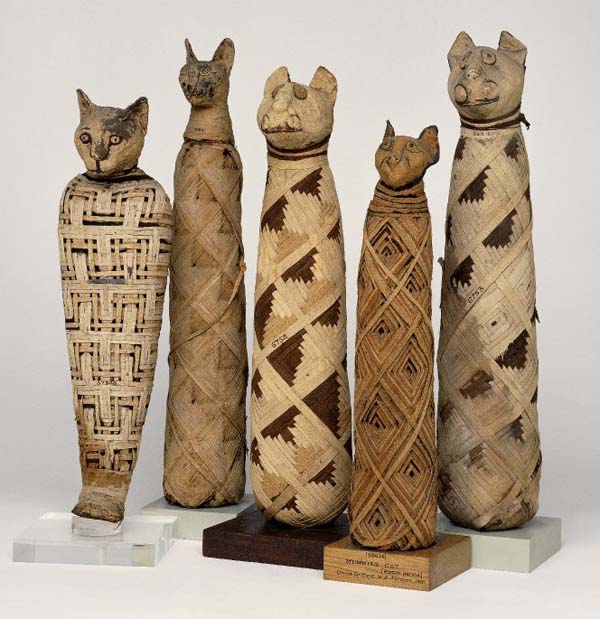
I talk like this to my cat sometimes. Pretty stupid, right? Well, at least I’m not the first to descend to this level. The Egyptians were crazy cat ladies too, although they took it to a much greater extreme.
In 450 BCE, the penalty for killing a cat was death. Exporting them out of Egypt was strictly forbidden, and an entire government agency was developed to repatriate kidnapped kitties to their home country. When a house caught fire people would rush inside to rescue their pets, but when this was unsuccessful the bodies were embalmed and buried with great honor in special burial grounds. Over 80,000 cats were found in a Beni-Hassan tomb, along with supplies for the afterlife such as mice and milk.
Unfortunately, Cambyses of Persia took advantage of this devotion during the Battle of Pelusium.
It began like any other war. The two armies marched out to meet each other, spears bristling, armor rattling--but then the Egyptians noticed something strange on the Persians’ shields. They were covered with paintings of Bastet, the cat goddess. Sacrilege!
As if that wasn’t bad enough, Cambyses ordered hundreds of sacred animals, including cats, to be driven before his army. The Egyptians were horrified. They couldn’t fight back without hurting one of their beloved companions. Ultimately this led to the destruction of Pharaoh’s army, and Persia emerged victorious. According to legend, Cambyses hurled cats at the Egyptians during his parade through the city, mocking their shameful defeat.
Isn’t that ridiculous? Why would somebody sacrifice their freedom for a cat? I would never--oh wait. You’ll have to excuse me. Cinnamon wants me to rub him. And after this I’ll have to scrape out his litter box, pick fur off my clothes, bandage my scratched hands, refresh his cat chow…

Do any of you guys have cats?

Mummified cats.

Tuesday, 4 November 2014

I Wish

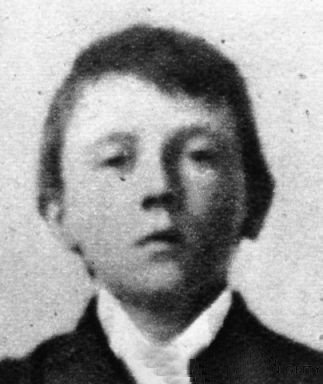
Adolph Hitler as a child.
While Adolph Hitler wasn’t solely responsible for World War II, I think we can all agree that he was one of the instigators. Think of him as a match and Germany as a gasoline puddle. While something probably would have sparked conflict eventually, without Hitler it might not have been as devastating. The Allies realized this and took every opportunity to shoot at him.
None of the assassins were successful, and ironically Hitler’s closest encounters with death happened by chance. Both times he survived--but only because bystanders went out of their way to rescue him.
Hitler’s life was first threatened when he was a child. One day, while playing on the banks of the River Inn, he tumbled into the water and was swept off by the current. Fortunately--or unfortunately, depending upon your perspective--another boy named Johann Kuehburger dove after him. He dragged Hitler ashore, saving one life and unwittingly dooming eleven million others.*
Several years after the river incident, Hitler once again brushed shoulders with death. This time it happened during one of World War I’s final battles, in which he made the mistake of crossing into a British soldier’s line of fire. They locked eyes for a moment. But when the Englishman saw that Hitler wounded, he allowed him to flee.
My brother was incredulous when I told him these stories. “We came so close! Why couldn’t we have killed Hitler when we had the chance?”
That was my reaction too. Millions of lives might have been saved if Kuehburger hadn’t rescued him, or the Englishman had pulled the trigger. But then I realized what we were wishing for. We were wishing that Kuehburger let a little boy drown. We were wishing that the soldier committed murder. At the time, Hitler was guiltless. It would have been unjust to hurt him.
Still. I wish.


*It should be noted that the evidence supporting this particular story is ambiguous, based mostly upon the word of Kuehburger’s friend and some vague newspaper clippings.

Wednesday, 29 October 2014

Three Unsolved Historical Mysteries

An engraving showing victims of the Dancing plague

#1 - Dancing Plague
During July of 1518, dozens of people in the French city of Strasburg were seized with disco fever and literally danced themselves to death. It began with one woman, Frau Troffea. One day, as she was walking down the street, she started convulsing in time with an unheard beat. Several neighbors joined her, and by the end of the week 30 people were cavorting around Strasburg like some sort of medieval flash mob. Victims reportedly danced nonstop for nearly six days before dying of strokes, heart attacks, and exhaustion.
Nearly five-hundred years later, scholars are still trying to uncover the cause of the Dancing Plague. Somebody suggested that the victims were suffering from stress-induced psychosis, but that doesn’t quite cut it for me. Mental illness isn’t contagious, and the Dancing Plague seems to be, judging by the way it spread from Troffea to her neighbors. Another theory blames erot fungus, the organic version of LSD. But again, that’s not contagious. And erot fungus is more likely to kill you than give you happy feet.
Personally, I think Strasburg was infected with Jitterbugs.

#2 - Lost Colony of Roanoke
In August, 1587, over a hundred men, women and children established a colony on Roanoke Island, just off the coast of North Carolina. At first everything went according to plan. Houses were built, crops were planted, and the settlers celebrated the birth of the first English child to be born in the New World.
Unfortunately, supplies ran low after a few months. The governor was sent back to England for more, but war broke out while he was there, and delayed his return for three years.
When he finally reached Roanoke, the rest of the settlers had disappeared. To this day, nobody knows what became of them. The only clue to their fate was the word “CROATOAN” carved on an old fencepost.
“CROATOAN” is an aggravatingly ambiguous phrase. It could refer to the local Croatoan Island, to which the colonists may have relocated, or to the Croatoan Indians, who may have attacked them or let them join the tribe. Testing has been conducted to see if modern Native Americans carry English DNA, but so far the results have been inconclusive.

Kaspar Hauser
#3 - Kaspar Hauser
One day in May, 1828, a shoemaker named Georg Weickmann noticed a strange boy tottering around Nuremburg as though drunk. He wore peasant clothes and carried a letter addressed to the local calvary captain. Weickmann decided to play the Good Samaritan and showed him to the officer’s house.
After awhile it became apparent that the boy wasn’t drunk. He was simply in awe of his surroundings and still learning to walk. His feet were blistered, as though unaccustomed to shoes, and when the captain’s servants offered him food, he spat it out in surprise. Naturally Weikmann and the captain questioned him, but all the boy knew how to say was “I don’t know” and “I want to be a rider the way my father was.”
Nobody knew what to do, so they called the police and locked him in the Vetsner Gate tower. While there, he gradually learned more German, and revealed his strange story to one of the jailers.
The boy said his name was Kaspar Hauser. He claimed to have spent all of his life in a dark cell, with no human contact except for a mysterious cloaked figure who left food on occasion. A tall tale, perhaps, but circumstances backed his story. For instance, Kaspar had an abnormality in his knees, suggesting that he hadn’t been able to stand up straight, and his behavior was incredibly childlike.
Kaspar said he had only recently left his cell. Apparently the cloaked figure decided to release him. He taught the boy how to walk and speak, then shoved a letter into his hand and sent him on the road to Nuremburg with strict instruction to join the calvary.
As you might expect, Kaspar’s story turned a lot of heads. Visitors mobbed the tower to stare at him, and there were whispers that he might be royalty--perhaps even the rightful prince of Baden. All of this attention overwhelmed Hauser, and it was agreed that he should be placed under the guardianship of a college professor.
To complicate things even further, the cloaked figure made a reappearance, perhaps angry that Kaspar had not joined the calvary. While the professor was gone, he cornered the boy and tried to assassinate him, but Hauser escaped with only a slight wound.
After this he was tossed back and forth between several more guardians, the figure tried to kill him again but was unsuccessful, and the public became more critical of Kaspar’s account. Some called him a liar. After all, there were gaping holes in his story. For example, Hauser claimed to have been fed exclusively bread and water during his confinement. Nutritionally speaking, that’s impossible. He would have starved years ago. Could it be that this was just a ploy for attention?
Unfortunately, Kaspar died before more conclusive evidence could be discovered. On December 14th, he stumbled into the house with a chest wound which he claimed was from the cloaked figure. Nobody took him seriously enough to call a doctor, and he died just a few days later.

Thursday, 16 October 2014

Visit to the Chicago Art Institute

((Disclaimer: I’m writing most of this from memory. Unlike the rest of my articles on this blog, I can’t vouch for the content’s complete accuracy.))

Last week I met the Greeks, Romans, Byzantines and Etruscans at the Chicago Art Institute. The experience was transcendent; I teared up when I saw the Athenian vases. Some long-dead artist touched those pots. I could have touched them too if I’d had a hammer for the display case.
My favorite pieces were two Fayum portraits, shown below. Since nobody knows the names of the subjects, I decided to call the cheerful man Jerry. The other is his surly friend, Damien.

Jerry

Damien


Fayum portraits are essentially mummy masks, although prior to the subject’s death they were kept on display in the house. These two hail from Roman Egypt sometime in the second century. The gold laurels you see around Jerry’s head were added after he died--one last way to flaunt his wealth. I think Damien’s jealous.
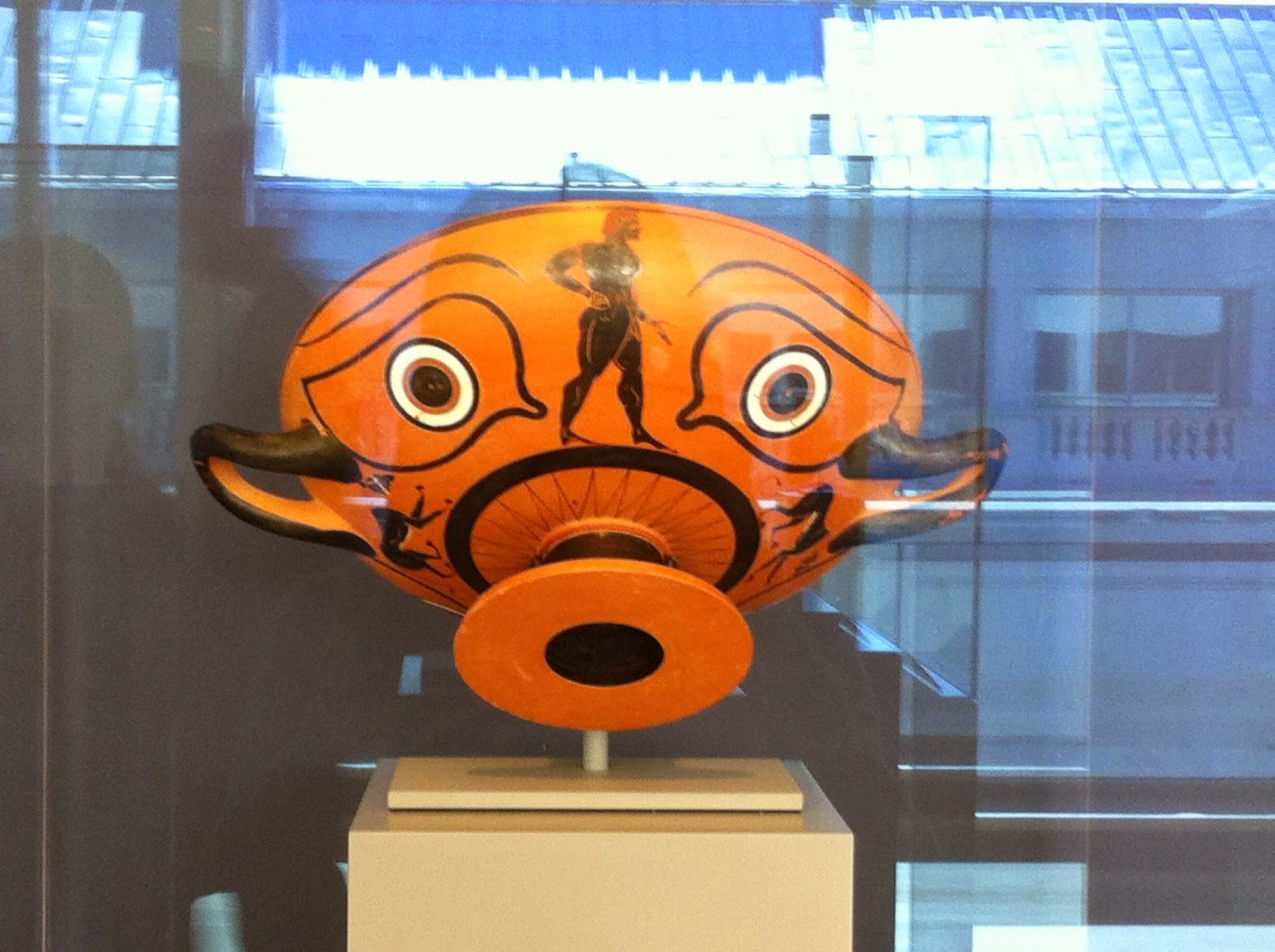
Here’s another one of my favorite exhibits: the Greek Eye-Cup.


When used as a drinking vessel, the bottom of the bowl creates a mask, complete with an open mouth and handles for ears. It is thought that Eye-Cups were related to related to Dionysus somehow, seeing as he’s the god of wine and theatre.
Another Greek exhibit included gravestones, known as steles. Usually sculptures aren’t my thing, but the emotion captured in these figures was enough to stir the most jaded heart. Take the picture below for example, in which you can see a couple clasping hands. Maybe they didn’t want to let go. Or perhaps the family wanted to show that they were still linked to their loved one. Whatever the case, it made the Greeks much more relatable.


And maybe that’s what I loved about the Art Institute. Maybe that’s what I love about history. It reveals what makes us human. Two-thousand years ago, a woman became a widow. Two-thousand years ago, fathers drank from the Eye-Cup while their children pointed and laughed. We like to think we're more advanced in the twenty-first century, but we haven't changed much. I don't think we ever will.

Tuesday, 23 September 2014

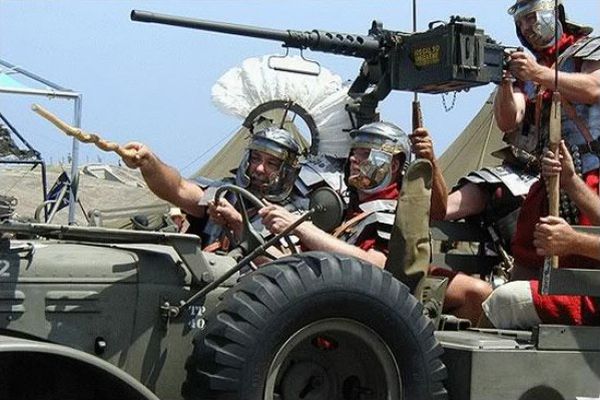
Rome VS Marines!


Imagine this: you’re a US Marine trudging through Afghanistan. Suddenly there’s a flash of light and poof! Your entire unit has been transported back in time to the reign of Augustus. For some reason you are seized with the urge to conquer the Empire. Although the Doctor always said never to tamper with fixed points in time...
Believe it or not, this situation was the source of great debate a few years back. Somebody on Reddit asked if a single MEU would be able to subjugate the entire Empire, and it went viral in minutes.
An MEU is about 2200 troops, plus artillery and vehicles. They poof onto the banks of the Tiber, not too far from the capital of Rome, but are unable to restock on supplies from the modern world. Once they run out of bullets, they can’t get any more. Making their own would be impossible without the proper equipment. And then you’ve got to think about electricity, batteries and gasoline. While they would dominate for a couple of days, the Romans would gain the upper hand when supplies ran out.
The Empire, however, has the opposite situation. They’ve got plenty of resources, but their equipment is suddenly antique. Armor wouldn’t hold up against a bullet. In fact, it would distort the bullet’s shape and make the wound worse. The men never would have heard an explosion before, and gunfire would shred the horses.
We should also assess the differences in their fighting tactics. While both groups emphasize aggression, unit cohesion and flexibility, the Romans are accustomed to marching out side-by-side. If the Marines took advantage of this by engaging in guerrilla warfare, the Empire would suffer devastating losses. However, if the MEU didn’t move quick enough, they would be surrounded and forced to surrender.

Personally, I think the Romans would win. As much as I would like to see the American flag fluttering over the Coliseum, the Empire is too big to be overthrown in a day, and Marines are at a serious disadvantage as soon as their supplies run out. But you can disagree if you want. For once I welcome comment debates. Who do you think would win? Rome or the Marines?

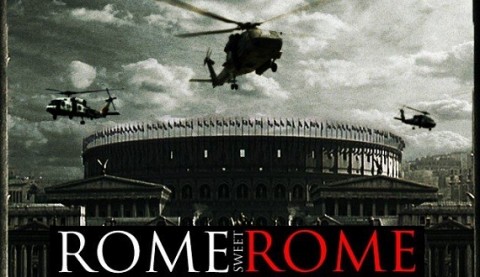
After the Rome VS Marines debate went viral, there was
 talk of making a move based on it, entitled "Rome Sweet Rome."

Wednesday, 17 September 2014

Five Funny Food Origins

Don’t give me that look. I know it’s been two weeks since I blogged. But here I am now, with another list of historical happening for your amusement. Please accept this as my apology.
And now, without further ado, Five Funny Food Origins!

The Earl of Sandwich. And a sandwich.


No. 1 - The Sandwich
In the 1700s, the Fourth Earl of Sandwich gambled for 24 hours straight, so engrossed by the game that he refused to leave the table. Unfortunately, his stomach didn’t share his enthusiasm. It grumbled about having no dinner until the Earl called for something to eat.
The cook brought him a piece of meat between two slices of toasted bread. The new dish was a hit with English aristocracy, retaining the name sandwich in honor of its creator.
It should be noted that variations of the sandwich had existed years prior to the incident. But this is what made it popular, and gave it the name we all know today.

No. 2 - Sirloin
One day in 1617, King James was served a magnificent loin of beef. Oh the juiciness, the meatiness, the gravy-ness! He was so enraptured by the dish that he ordered a couple of pages to bring it before his throne. James drew his short sword and knighted it Sir Loin--a name that meshed over time into sirloin.
Historians are divided on the authenticity of this legend. But whatever the case, I think it’s an interesting story.

No. 3 - Popsicle
In 1905, 11-year-old Frank Epperson let his drink freeze on the patio overnight. The next morning he yanked the block of ice out, gave it a lick, and found it delicious. It was an experience he never forgot. When Frank grew up he acquired a patent and shared the recipe with his children, who called the strange new treat Pop's 'Sicles.

No. 4 - Pretzels
Soft-dough pretzels were invented by a frustrated Italian monk in the 7th century, who hoped to use them as bribes for his catechism students. In fact, the middle pretzel loop is supposed to resemble a child’s arms folded in prayer.

No. 5 - Tea Bags 

Thomas Sullivan created tea bags on accident in 1908 when he distributed samples of his tea in little silk sacks. Some consumers, supposing that the sacks were like metal infusers, dropped them into the water. The result was just as good as traditionally steeped tea, and soon Sullivan was bombarded with orders for this new convenience.

Tuesday, 2 September 2014

Ancient Greek Cooking - Loukoumades and Figs

Some of the greatest politicians, poets and philosophers hail from Greece. They invented ship-sinking claws, founded the first republic, instituted the art of geometry and... made awesome donuts!
Seriously, though. they are good donuts. I tried the recipe yesterday, and thought I’d share the origins and instructions.
The proper name for the donuts is actually Loukoumades, although the poet Callimachus referred to them as “honey-tokens.” They were served to Olympic champions, and are one of the most ancient recorded deserts. The taste is subtle compared to modern pastries, just a burst of honey and a crunch from the crust. Personally I thought they were hard to prepare--lots of deep-frying was involved, and the dough was pretty gloppy--but the end product is well worth the effort.

These are our failed Loukoumades. They didn't fry all the way through.
These ones came out great. The bowl on the right is gluten free!

Another Greek staple that I decided to try was figs.
Figs have a long and illustrious history reaching all the way back into Biblical times. The Egyptians ate them. The Greeks lived on them. Roman Emperors served them at feasts and now they have reached my plate as well. Actually you don’t need a plate. Figs can be eaten whole. Just pop ‘em in your mouth.


I’m not sure how to describe the taste. It’s sweet. But not incredibly sweet. I guess the closes thing I can compare it to is watermelon, although the texture is quite different. More in line with a grape, I guess.
Well there you have it: my Greek victory feast. I have included a link to the Loukoumades recipe we used at the bottom of the post. If you decide to give it a try, let me know in the comments!