Monday, 15 June 2015

Exposure

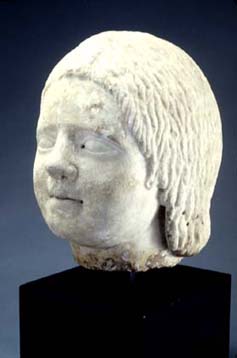
Bust of a young girl.

     Every Roman's life began with the same ritual: Directly after birth, the midwife placed it on the floor. Best case scenario, Dad picked it up again, acknowledging the child as his own. Unfortunately, not every story ended so happily.
     Sometimes Dad hesitated. He bit his lip. He glanced at his wife, then at the baby, and finally shook his head. A slave was dispatched to abandon the child, a practice known as exposure.
Roman father and son.
     Nobody knows how often this situation played out. Some historians claim that it was a commonplace thing, while others argue that it was much more rare. Regardless, at least a few infants were abandoned up until the later days of the Empire.
    Apalling, I know. But before passing judgement, let's take a closer look at the parents' plight. What could possibly motivate a father to expose his child?
     For many, the answer was deformity. In Gynecology, Soranus gives step-by-step instructions on how to recognize a newborn worth rearing. Midwives were advised to check "that its ducts… are free from obstruction; that the natural functions of every <member> are neither sluggish nor weak; that the joints bend and stretch; that it has due size and shape and is properly sensitive in every respect." While some fathers decided to raise disabled children anyway, at least a few were cast out, perceived as a bad omen by their superstitious parents.
     Even if the infant met all of Soranus' criteria, it was still in peril of exposure, especially if it was female. According to one comic poet, "Everyone raises a son, including the poor; but even a rich man exposes a daughter."
     But why? What's wrong with girls?
     According to custom, every bride required a dowry. And since every girl became a bride, Dad would have to dish out oodles of money, which might have been needed for that month's groceries. Girls simply weren't viable. All too often their father was forced to choose between raising them or financial stability--a situation dramatized in Ovid's Metamorphoses. Below is an excerpt from the poem, explaining a husband's prayer for his pregnant wife:

     "There are two things I pray to heaven for
     On your account: an easy birth and a son.
     The other fate is much too burdensome,
     For daughters need what fortune has denied us:
     A dowry…."

     Another influencing factor was Rome's callous attitude toward newborns. Cicero explains it best: "If a child dies young, one consoles himself easily. If he dies in the cradle, one doesn't even pay attention." Plutarch goes even further. "Until [the umbilical cord] comes off," he writes, "the child is more like a plant than an animal." While this attitude braced parents for staggering infant mortality rates, it may have softened the idea of exposure as well.
     Finally, as Dad sent his daughter away, he may have hoped that a childless couple would adopt her. It wasn't unheard of. After all, Oedipus was raised by a king. Romulus and Remus were suckled by a wolf. At least the baby had a chance this way--although wild dogs might get to it first.
     Bear with me, modern readership. I know this is a gloomy article, not everyone in the ancient world agreed with exposure.
     Take the Stoics for example. Their philosophy taught that children were the whole point of marriage, and spoke against all forms of family limitation. Christians took a similar stance. Opposition to exposure became more widespread during the third century, and Constantine decreed in 331 that anyone who abandoned an infant lost patria potestas (similar to custody) over the child. Orphanages were founded during the 4th century as well, and charity was sent to impoverished families.
     While Constantine never outlawed exposure, these preventative measures represent a significant change in the way that Romans viewed newborns. Raising children in the Ancient World certainly wasn't easy, but Dad had more options now, and the future was brighter for his abandoned daughter.

Wednesday, 18 March 2015

A Matter of Perspective


Recently I received Suetonius’ Lives of the Twelve Caesars, and it reads like a gossip magazine. Poison! Intrigue! Murder! By the end of the exposé on Nero, I was wondering how such a loony rose to power in the first place.
If my opinion of Nero was built entirely upon Suetonius, it would be very disproportionate. The writer had his own agenda. His own biases. And thousands of years later, here I am, innocently lapping it up.
In order to understand an event, it’s necessary to consider different perspectives, weighing their beliefs and prejudices. This is especially difficult with contemporary accounts, also known as primary sources.
I first heard this from my history teacher, Mrs. Smith*. She explained that different people have different perspectives on the same event, and to demonstrate she invited two eyewitnesses of 1981 Springbok Tour to take questions from the class.
But first, a bit of background.
During the 1980s, South Africa was in the grip of apartheid--a regime so cruel that the international community decided to exclude it. New Zealand, however, wasn’t too keen on the idea. Kiwis and Afrikaans had developed a friendly rugby rivalry that thrilled fans on both sides. Ostracizing South Africa would mean an end to that. “And anyway,” some argued, “politics shouldn’t interfere with sport.”
Thus armed, the New Zealand Rugby Football Union arranged for the South African team, the Springboks, to visit their country for a 16-game tour. Rugby fans rejoiced--but not everybody shared their enthusiasm. Human rights activists called it an outrage. In their opinion, fraternizing with the Afrikaans was immoral, as well as damaging to New Zealand’s image. Thousands took to the streets in protest--Ms. Smith’s first witness was one of them. 


His name was Mr. Johnson*. He was tall, tan and wore a life preserver. Upon entering the classroom he started bellowing an old protestors’ chant: ONE, TWO, THREE, FOUR! WE DON’T WANT YOUR RACIST TOUR! FIVE, SIX, SEVEN, EIGHT! STOP THE TOUR, IT’S NOT TOO LATE!
I jerked back in my seat. That was loud. To make matters worse, Mr. Johnson started drumming on a trashcan lid, which he had been carrying like shield. The class was transfixed. What the heck was going on?
Mr. Johnson explained that the life preserver and trashcan lid were a homemade suit of armor for protection against the riot police. They weren’t afraid to use violence. Cops marched into huddles of protestors, swinging long-batons and hollering, “MOVE. MOVE. MOVE.” Mr. Johnson demonstrated with a baseball bat to make sure we got the idea.
Once I recovered from my initial shock, I was enraptured by the interview. Mr. Johnson was a terrific speaker--made the protest sound like a crusade against racism. The police became mindless henchmen, Nelson Mandela was their figurehead, and martyrs emerged from the riots.
But Mrs. Smith wasn’t done yet. She still had one witness left--a policeman who spent the Tour fighting people like Mr. Johnson. Unfortunately he passed away a few years ago, so we had to watch a taped interview with another class.
The policeman was quiet. Gravelly. Morbid. He reminded me of an old war veteran. While Mr. Johnson spoke in terms of moral duty, the policeman acted as though he were dispelling a myth, turning the Springbok Tour into a cautionary tale.


Turns out, the protestors gave as good as they got. Property was destroyed. Cops were bashed. The policeman labeled most of the activists as hypocrites, recalling a priest whom he had seen babbling prayers and spreading glass on a rugby pitch. After that, the policeman’s faith in the Church was shattered. My own anti-tour sympathies collapsed altogether.
Which side was right? I wasn’t sure. Previously I had assumed that the protesters were good because they were against racism, but the police had some valid points too. I couldn’t just brush them aside.
My eventual conclusion was that nobody was completely right. The protestors shouldn’t have hit the police and the police shouldn’t have hit the protestors. That was a much more mature opinion than the one I’d held previously. Both sides of the argument were needed to balance it.
So next time you’re examining a primary source--be it neighborhood gossip or Suetonius’ biography of Nero--try playing devil’s advocate. What would the opposition say? What is the author’s motivation? Suetonius, for example, wanted to sell his book. Mr. Johnson and the policeman may feel the need to justify their actions, although that’s not a bad thing. Perspective is an instinct. It slips in, unnoticed, and skews the world in our favor.
You can try now, if you want. Below I have shared two taped interviews with eyewitnesses to the Springbok Tour. Compare, contrast, and let me know what you think!


An interview with a member of the Blue Squad (riot police)


Perspectives from a former rugby player and Marx Jones, a man who rented an aeroplane and lobbed flour bombs into a stadium to protest the Springbok Tour.


*Stalkers should note that names have been changed to protect the innocent.

Tuesday, 10 February 2015

Peek-A-Boo

Engraving of Emperor Nero
Every so often during the course of my research, the author will share a historical anecdote. Characters pop in for the duration of a paragraph, then disappear, leaving us to wonder about the rest of their lives. Feels like an archaic game of peek-a-boo.
Take this situation, for instance. Suetonius tells us that Emperor Nero fancied himself a great actor. Usually the audience endured his productions without comment, but something unexpected happened during “The Frenzy of Hercules.”

“They say a young recruit, seeing the emperor in mean attire and bound in chains, as the subject required, rushed forward to lend him aid.” (Suet. Nero, 21)

Can you imagine that?
One moment you’re watching Nero sing off-key in a Hercules costume. Then somebody dashes across the amphitheater. Is it an assassin? Another actor? No. It's a soldier. He's onstage now. He’s sprinting toward the Emperor. He’s offering him a hand, shouting, “Don’t worry, sir, I’ll save you! Have a seat while I sort out the plot.”
Poor kid. Seems he couldn't bear seeing Nero in trouble--even if it was just make-believe. Or perhaps he was so moved by the Emperor's plight that he forgot it was pretend. Either way, he must have been embarrassed afterward. I just hope he didn't get in trouble.
Another short story can be found on an Ancient Greek grave inscription. This time, as an added bonus, the characters are given names: meet Mikkos, a wet nurse, and Aischre, her charge.

Mikkos looked after Phyrgian Aischre all her life, even in old age. When she died he set up this monument for future generations to see. Thus the old woman departed from this life, having received due recompense for her breasts.

Did you catch the mock-heroic tone? Says a lot about their relationship. I imagine there was a lot of sarcastic give-and-take. What makes this story even more remarkable is that wet nurses were often slaves, and while we can’t be certain that Mikkos was one, it’s a possibility.
I've taken a lot of creative license in this article. There's no way of knowing what these people were like--but that's one of the reasons I love these short stories so much. There's room for the imagination. Our minds begin to fill in the blanks. We find ourselves sympathizing with people from vastly different cultures, who died hundreds of years ago. For me, at least, these stories bring the dead back to life.
But enough about what I think. What do you think?
What were Mikkos and Aischre like? Why did the recruit care so much about Nero?

Greek funerary stele

Wednesday, 7 January 2015

Renaissance Armor

The Chicago Art Institute never ceases to amaze. In addition to the prints featured in last week’s post, a spectacular array of Renaissance weaponry was on display. While not technically apart of the Middle Ages, the sight of halberds and jousting equipment evokes images of King Arthur. Check out the suit below and you’ll see what I mean.


While this suit of armor definitely looks Arthurian, it’s actually an example of 16th-century German craftsmanship. The rounded shaped, curved breastplate, sharp edges and roped gauntlet were designed to guard against thrusts. And see the hook under the collarbone? That was supposed to help the knight with his lance.
Speaking of which...


These halberds harken back to the late 16th and early 17th century, by which time firearms had begun to usurp traditional weaponry. As such, the ones pictured above were mostly used for ceremonial purposes. Often pole arms like these were engraved with their lord's coat of arms.


The "proof mark," underneath the lance hook.
As I said earlier, guns were making their battlefield debut, driving old-fashioned warfare into retirement. This suit is a prime example of that transition, being one of the last examples of cuirassier calvary. Adjustments have been made to protect the wearer from musket fire--notice the thick helmet and breastplate. A slight dent called a “proof mark” can also be seen below the lance hook. This is where the smith shot a bullet into the steel to prove it would guard against firearms.


While I found the previous exhibits intriguing, hands-down favorite was the armored horseman pictured above. Can’t you imagine him lowering his lance and galloping off the pedestal? 
Readers should note the different segments of armor: round helmet, curved breastplate and foot guards. Each is made out of small armor plates and ridges designed to imitate pleats, removing extra pounds of steel from the knight’s shoulders.

Do you lament the collapse of medieval warfare? Or do you think we’re better off with firearms?

Tuesday, 30 December 2014

Ghosts and Demons in Japanese Prints

I’ve been itching to revisit the Chicago Art Institute, and over Thanksgiving I got my wish. This time we were able to tour the entire museum, including a special exhibit on ghosts and demons in 19th century Japanese prints.
One of the most ingenious pieces on display depicted a scene from a kabuki performance. As you can see, the center figure is pouncing upon a hapless damsel, having transformed from a maiden to a ghoul. This required a rapid costume change from the actor, which we can observe by turning a flap on the print. Kind of like a children’s book.

Turn to the right, and it’s a woman.

To the left, and it’s a ghoul.
The second print was far more frightening. In it we see a ghost made of ceramic plates, rising into the coal-black sky bent on haunting her murderous husband. According to legend, he slew her for breaking the dishes, but in death she found power that she never had in life.


Hide your eyes, because this next print is even spookier. This time a ghoul is in the bedroom, peeking through the mosquito netting at the treacherous couple who drowned him. Aren’t the colors incredible? And look at those tendrils by the ghost’s skull. They remind me of seaweed, perhaps alluding to his watery grave.


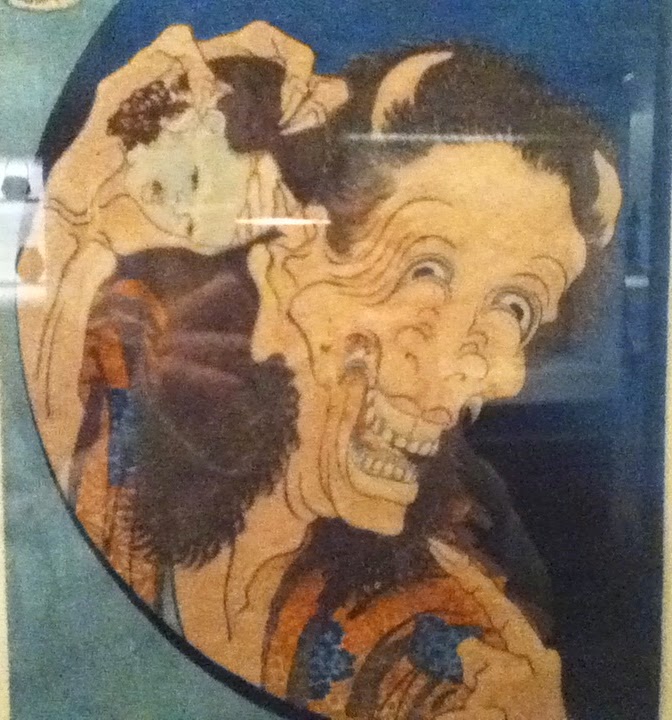
Alright everyone, calm yourselves. Warai Hannya, pictured below, is our last demon. She was known for preying upon children and even clutches a head in the print. Nice lady, right?


Now that you’ve been thoroughly spooked by the bad guys, it’s time I introduced you to a hero. Meet Shōki the Demon Queller. In the print below you can see him astride a slavering tiger, mincing goblins to chutney with a wicked-blue sword. Pictures like this were displayed for the Boys’ Day festival, and Shōki banners were used as a safeguard against disease. I guess that sword kills bacteria as well as demons.


What did you think of the prints? Do you have a favorite? Or are they too grotesque for that?


Friday, 26 December 2014

How To Make An Authentic Chiton

The other day whilst perusing the Internet, I came upon a set of instructions for making a chiton, or Greek tunic. It’s surprisingly simple, and best of all no sewing is required. All you need is a white sheet, five safety pins, a belt, and a friend to model it for you. The latter was supplied by one of my buddies, who we’ll just call Mymy.

STEP ONE - Fold the sheet lengthwise until it’s as long as you want the chiton to be. Traditionally it was worn to the ankle, but Mymy and I decided to be scandalous and made ours shorter.


STEP TWO - Grasp one side of the sheet and hold it in front of your body. Note that I said side, not corner. You want to grab the cloth a few inches behind that. See how Mymy holds it?


STEP THREE - Wind the other half around your back.


STEP FOUR - Pin the two top corners together. If you don’t have a pin, hairbands will suffice.


STEP FIVE - Take the piece of material held in your right hand and attach it to the corresponding cloth behind your back. Greek women used brooches, but again, pins or hair ties will suffice. Once this step is completed, you will have created the first sleeve. Slip your arm through.


STEP SIX - Repeat Step Five using the material in your left hand.


STEP SEVEN - Next pin the slit on your left together. Tie a belt around the middle, strike a pose, and you’re done. Congratulations!


If you decide to give the chiton a try, let me know how it went in the comments. I’d be happy to answer any questions.

Tuesday, 2 December 2014

The Leper King

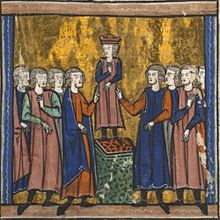
Tutor discovers Baldwin's leprosy
In 1170, Prince Baldwin’s tutor noticed something strange about him. He felt no pain while roughhousing with the other boys, even when they dug their fingernails into his arm. Soon it became apparent that the young prince had contracted leprosy. He was only nine years old.
Tragedy struck again in 1174. The king was dead, and the only possible successor was Baldwin, who was by this time in his early teens. Managing an Empire is a major undertaking, even for an adult, but Baldwin had neither experience nor health on his side. Right from the beginning, his reign appeared to be doomed.
And yet despite the odds, Baldwin clung to the throne. He lived under the guidance of regents until the age of fifteen, then assumed full control of Jerusalem. By this time he was noticeably sick with leprosy. The last thing he needed was a kingdom to worry about, but once again Baldwin did not shirk from leadership.
One of his first decisions was to attack the Muslim king, Saladin, who had been plundering Syrian village of Aleppo. If Syria fell, Jerusalem would soon follow. It was a brittle situation requiring uncommon wisdom. One wrong move could result in the death of thousands, but Baldwin proved to be an excellent strategist. First he struck Damascus, putting Saladin on the defensive, then forged an alliance with the Byzantine Empire and prepared to attack Egypt. Unfortunately an important member of the raid died, Baldwin’s own health began to wane, and the invasion was canceled.
About this time several nobles stripped their support from Jerusalem, leaving the city only 600 knights and a few thousand infantrymen to face Saladin’s army. With the enemy just 45 miles away, the time had come for Baldwin to make a final stand. He rose from his sickbed, mounted his horse and stood in the path of Saladin’s force.
A contemporary author wrote that Baldwin appeared “already half dead.” The rest of the army wasn’t much better. The sight of the teeming Muslim soldiers drove knives into their hearts. Perhaps sensing this, Baldwin called for the Bishop of Bethlehem to present the relic of the One True Cross. The king prostrated himself before it, prayed earnestly for victory, and encouraged the troops to hold fast.
After that, the Leper King led the charge. He raised a sword with one bandaged hand, striking down the enemy wherever they dared appear. The people said Saint George road beside him, and under Baldwin’s leadership the crusaders not only defended Jerusalem but utterly trounced the invaders. Almost ninety percent were killed. Saladin himself barely escaped.
Baldwin returned home victorious, but his troubles weren’t over yet. Illness plagued the Leper King all of his life, rendering his arms, legs and vision useless. Several times he tried to abdicate, but was unable to find a suitable replacement. He died of sickness on May 6, 1185, and without his guidance Jerusalem fell to Saladin two years later.


Tuesday, 18 November 2014

Egypt - Land of the Crazy Cat Ladies

My baby and despot,  Cinnamon.
“Mommy wuvs her baby. Yes her does! Yes her does! Mommy wuvs her baby more den wife itself. Mommy would do anyfing for her baby...”
I talk like this to my cat sometimes. Pretty stupid, right? Well, at least I’m not the first to descend to this level. The Egyptians were crazy cat ladies too, although they took it to a much greater extreme.
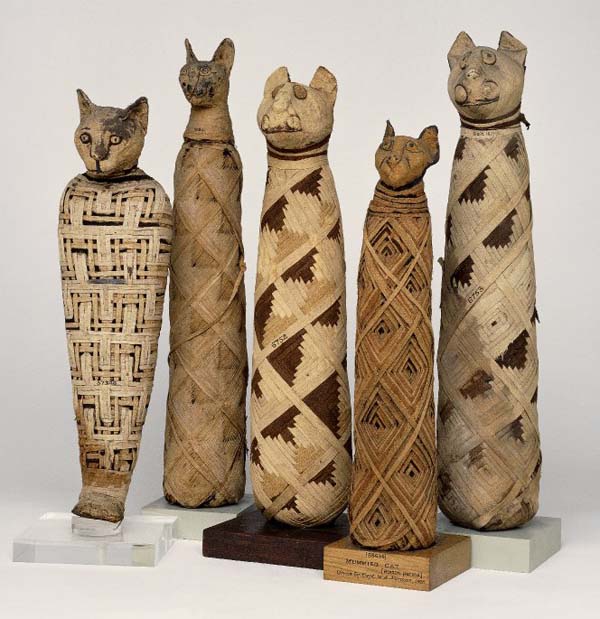
In 450 BCE, the penalty for killing a cat was death. Exporting them out of Egypt was strictly forbidden, and an entire government agency was developed to repatriate kidnapped kitties to their home country. When a house caught fire people would rush inside to rescue their pets, but when this was unsuccessful the bodies were embalmed and buried with great honor in special burial grounds. Over 80,000 cats were found in a Beni-Hassan tomb, along with supplies for the afterlife such as mice and milk.
Unfortunately, Cambyses of Persia took advantage of this devotion during the Battle of Pelusium.
It began like any other war. The two armies marched out to meet each other, spears bristling, armor rattling--but then the Egyptians noticed something strange on the Persians’ shields. They were covered with paintings of Bastet, the cat goddess. Sacrilege!
As if that wasn’t bad enough, Cambyses ordered hundreds of sacred animals, including cats, to be driven before his army. The Egyptians were horrified. They couldn’t fight back without hurting one of their beloved companions. Ultimately this led to the destruction of Pharaoh’s army, and Persia emerged victorious. According to legend, Cambyses hurled cats at the Egyptians during his parade through the city, mocking their shameful defeat.
Isn’t that ridiculous? Why would somebody sacrifice their freedom for a cat? I would never--oh wait. You’ll have to excuse me. Cinnamon wants me to rub him. And after this I’ll have to scrape out his litter box, pick fur off my clothes, bandage my scratched hands, refresh his cat chow…

Do any of you guys have cats?

Mummified cats.

Tuesday, 4 November 2014

I Wish

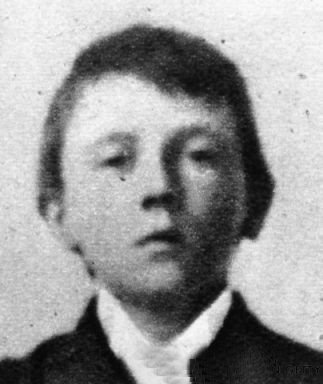
Adolph Hitler as a child.
While Adolph Hitler wasn’t solely responsible for World War II, I think we can all agree that he was one of the instigators. Think of him as a match and Germany as a gasoline puddle. While something probably would have sparked conflict eventually, without Hitler it might not have been as devastating. The Allies realized this and took every opportunity to shoot at him.
None of the assassins were successful, and ironically Hitler’s closest encounters with death happened by chance. Both times he survived--but only because bystanders went out of their way to rescue him.
Hitler’s life was first threatened when he was a child. One day, while playing on the banks of the River Inn, he tumbled into the water and was swept off by the current. Fortunately--or unfortunately, depending upon your perspective--another boy named Johann Kuehburger dove after him. He dragged Hitler ashore, saving one life and unwittingly dooming eleven million others.*
Several years after the river incident, Hitler once again brushed shoulders with death. This time it happened during one of World War I’s final battles, in which he made the mistake of crossing into a British soldier’s line of fire. They locked eyes for a moment. But when the Englishman saw that Hitler wounded, he allowed him to flee.
My brother was incredulous when I told him these stories. “We came so close! Why couldn’t we have killed Hitler when we had the chance?”
That was my reaction too. Millions of lives might have been saved if Kuehburger hadn’t rescued him, or the Englishman had pulled the trigger. But then I realized what we were wishing for. We were wishing that Kuehburger let a little boy drown. We were wishing that the soldier committed murder. At the time, Hitler was guiltless. It would have been unjust to hurt him.
Still. I wish.


*It should be noted that the evidence supporting this particular story is ambiguous, based mostly upon the word of Kuehburger’s friend and some vague newspaper clippings.

Wednesday, 29 October 2014

Three Unsolved Historical Mysteries

An engraving showing victims of the Dancing plague

#1 - Dancing Plague
During July of 1518, dozens of people in the French city of Strasburg were seized with disco fever and literally danced themselves to death. It began with one woman, Frau Troffea. One day, as she was walking down the street, she started convulsing in time with an unheard beat. Several neighbors joined her, and by the end of the week 30 people were cavorting around Strasburg like some sort of medieval flash mob. Victims reportedly danced nonstop for nearly six days before dying of strokes, heart attacks, and exhaustion.
Nearly five-hundred years later, scholars are still trying to uncover the cause of the Dancing Plague. Somebody suggested that the victims were suffering from stress-induced psychosis, but that doesn’t quite cut it for me. Mental illness isn’t contagious, and the Dancing Plague seems to be, judging by the way it spread from Troffea to her neighbors. Another theory blames erot fungus, the organic version of LSD. But again, that’s not contagious. And erot fungus is more likely to kill you than give you happy feet.
Personally, I think Strasburg was infected with Jitterbugs.

#2 - Lost Colony of Roanoke
In August, 1587, over a hundred men, women and children established a colony on Roanoke Island, just off the coast of North Carolina. At first everything went according to plan. Houses were built, crops were planted, and the settlers celebrated the birth of the first English child to be born in the New World.
Unfortunately, supplies ran low after a few months. The governor was sent back to England for more, but war broke out while he was there, and delayed his return for three years.
When he finally reached Roanoke, the rest of the settlers had disappeared. To this day, nobody knows what became of them. The only clue to their fate was the word “CROATOAN” carved on an old fencepost.
“CROATOAN” is an aggravatingly ambiguous phrase. It could refer to the local Croatoan Island, to which the colonists may have relocated, or to the Croatoan Indians, who may have attacked them or let them join the tribe. Testing has been conducted to see if modern Native Americans carry English DNA, but so far the results have been inconclusive.

Kaspar Hauser
#3 - Kaspar Hauser
One day in May, 1828, a shoemaker named Georg Weickmann noticed a strange boy tottering around Nuremburg as though drunk. He wore peasant clothes and carried a letter addressed to the local calvary captain. Weickmann decided to play the Good Samaritan and showed him to the officer’s house.
After awhile it became apparent that the boy wasn’t drunk. He was simply in awe of his surroundings and still learning to walk. His feet were blistered, as though unaccustomed to shoes, and when the captain’s servants offered him food, he spat it out in surprise. Naturally Weikmann and the captain questioned him, but all the boy knew how to say was “I don’t know” and “I want to be a rider the way my father was.”
Nobody knew what to do, so they called the police and locked him in the Vetsner Gate tower. While there, he gradually learned more German, and revealed his strange story to one of the jailers.
The boy said his name was Kaspar Hauser. He claimed to have spent all of his life in a dark cell, with no human contact except for a mysterious cloaked figure who left food on occasion. A tall tale, perhaps, but circumstances backed his story. For instance, Kaspar had an abnormality in his knees, suggesting that he hadn’t been able to stand up straight, and his behavior was incredibly childlike.
Kaspar said he had only recently left his cell. Apparently the cloaked figure decided to release him. He taught the boy how to walk and speak, then shoved a letter into his hand and sent him on the road to Nuremburg with strict instruction to join the calvary.
As you might expect, Kaspar’s story turned a lot of heads. Visitors mobbed the tower to stare at him, and there were whispers that he might be royalty--perhaps even the rightful prince of Baden. All of this attention overwhelmed Hauser, and it was agreed that he should be placed under the guardianship of a college professor.
To complicate things even further, the cloaked figure made a reappearance, perhaps angry that Kaspar had not joined the calvary. While the professor was gone, he cornered the boy and tried to assassinate him, but Hauser escaped with only a slight wound.
After this he was tossed back and forth between several more guardians, the figure tried to kill him again but was unsuccessful, and the public became more critical of Kaspar’s account. Some called him a liar. After all, there were gaping holes in his story. For example, Hauser claimed to have been fed exclusively bread and water during his confinement. Nutritionally speaking, that’s impossible. He would have starved years ago. Could it be that this was just a ploy for attention?
Unfortunately, Kaspar died before more conclusive evidence could be discovered. On December 14th, he stumbled into the house with a chest wound which he claimed was from the cloaked figure. Nobody took him seriously enough to call a doctor, and he died just a few days later.

Thursday, 16 October 2014

Visit to the Chicago Art Institute

((Disclaimer: I’m writing most of this from memory. Unlike the rest of my articles on this blog, I can’t vouch for the content’s complete accuracy.))

Last week I met the Greeks, Romans, Byzantines and Etruscans at the Chicago Art Institute. The experience was transcendent; I teared up when I saw the Athenian vases. Some long-dead artist touched those pots. I could have touched them too if I’d had a hammer for the display case.
My favorite pieces were two Fayum portraits, shown below. Since nobody knows the names of the subjects, I decided to call the cheerful man Jerry. The other is his surly friend, Damien.

Jerry

Damien


Fayum portraits are essentially mummy masks, although prior to the subject’s death they were kept on display in the house. These two hail from Roman Egypt sometime in the second century. The gold laurels you see around Jerry’s head were added after he died--one last way to flaunt his wealth. I think Damien’s jealous.
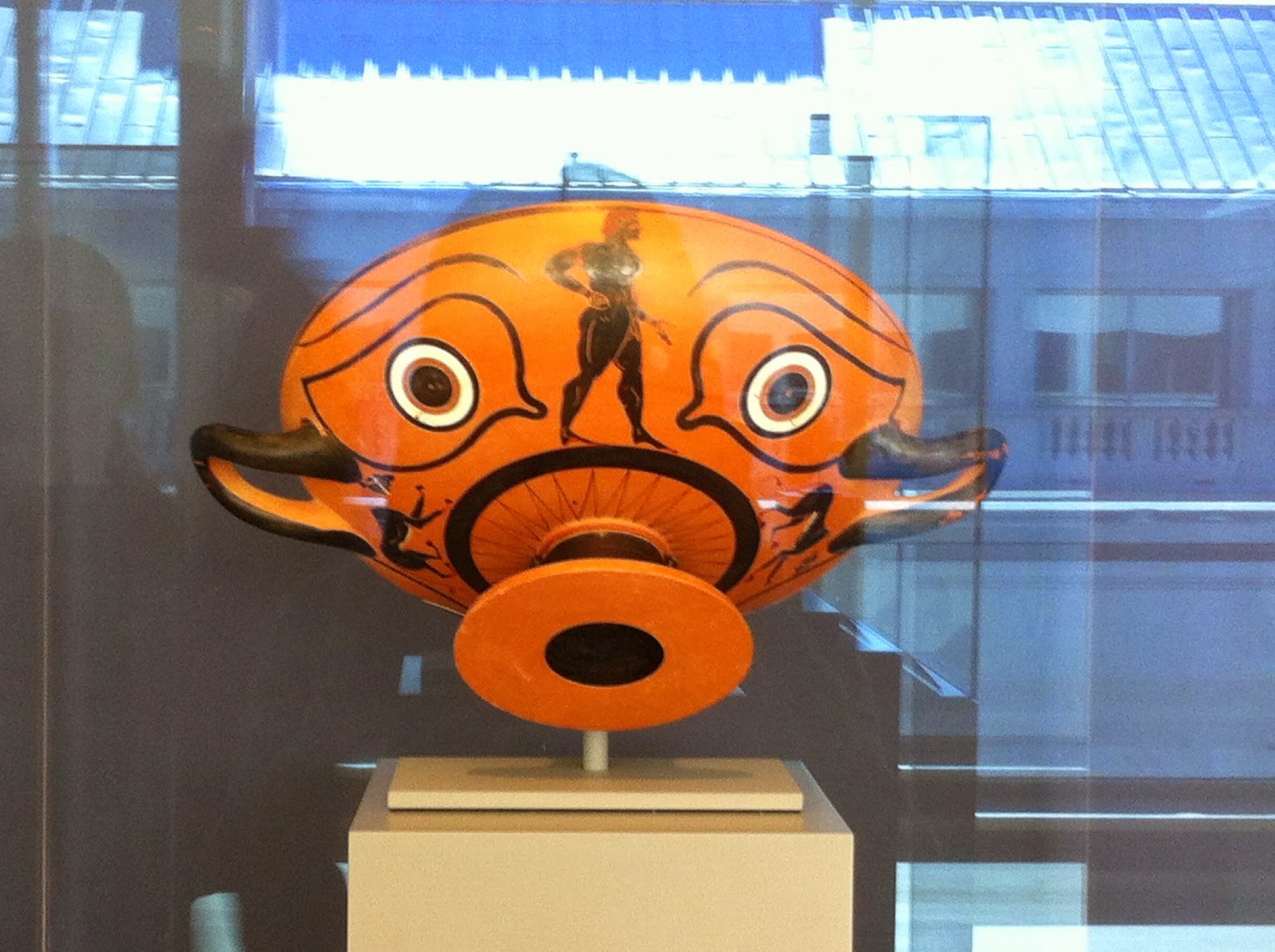
Here’s another one of my favorite exhibits: the Greek Eye-Cup.


When used as a drinking vessel, the bottom of the bowl creates a mask, complete with an open mouth and handles for ears. It is thought that Eye-Cups were related to related to Dionysus somehow, seeing as he’s the god of wine and theatre.
Another Greek exhibit included gravestones, known as steles. Usually sculptures aren’t my thing, but the emotion captured in these figures was enough to stir the most jaded heart. Take the picture below for example, in which you can see a couple clasping hands. Maybe they didn’t want to let go. Or perhaps the family wanted to show that they were still linked to their loved one. Whatever the case, it made the Greeks much more relatable.


And maybe that’s what I loved about the Art Institute. Maybe that’s what I love about history. It reveals what makes us human. Two-thousand years ago, a woman became a widow. Two-thousand years ago, fathers drank from the Eye-Cup while their children pointed and laughed. We like to think we're more advanced in the twenty-first century, but we haven't changed much. I don't think we ever will.

Tuesday, 23 September 2014

Rome VS Marines!


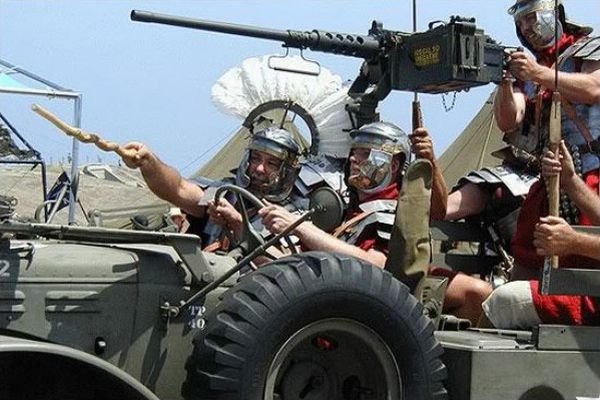
Imagine this: you’re a US Marine trudging through Afghanistan. Suddenly there’s a flash of light and poof! Your entire unit has been transported back in time to the reign of Augustus. For some reason you are seized with the urge to conquer the Empire. Although the Doctor always said never to tamper with fixed points in time...
Believe it or not, this situation was the source of great debate a few years back. Somebody on Reddit asked if a single MEU would be able to subjugate the entire Empire, and it went viral in minutes.
An MEU is about 2200 troops, plus artillery and vehicles. They poof onto the banks of the Tiber, not too far from the capital of Rome, but are unable to restock on supplies from the modern world. Once they run out of bullets, they can’t get any more. Making their own would be impossible without the proper equipment. And then you’ve got to think about electricity, batteries and gasoline. While they would dominate for a couple of days, the Romans would gain the upper hand when supplies ran out.
The Empire, however, has the opposite situation. They’ve got plenty of resources, but their equipment is suddenly antique. Armor wouldn’t hold up against a bullet. In fact, it would distort the bullet’s shape and make the wound worse. The men never would have heard an explosion before, and gunfire would shred the horses.
We should also assess the differences in their fighting tactics. While both groups emphasize aggression, unit cohesion and flexibility, the Romans are accustomed to marching out side-by-side. If the Marines took advantage of this by engaging in guerrilla warfare, the Empire would suffer devastating losses. However, if the MEU didn’t move quick enough, they would be surrounded and forced to surrender.

Personally, I think the Romans would win. As much as I would like to see the American flag fluttering over the Coliseum, the Empire is too big to be overthrown in a day, and Marines are at a serious disadvantage as soon as their supplies run out. But you can disagree if you want. For once I welcome comment debates. Who do you think would win? Rome or the Marines?

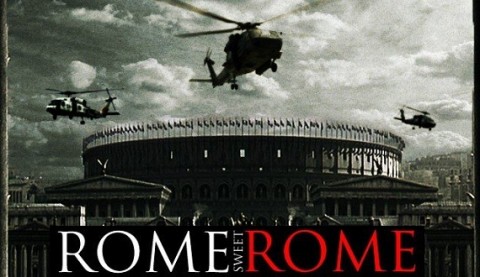
After the Rome VS Marines debate went viral, there was
 talk of making a move based on it, entitled "Rome Sweet Rome."

Wednesday, 17 September 2014

Five Funny Food Origins

Don’t give me that look. I know it’s been two weeks since I blogged. But here I am now, with another list of historical happening for your amusement. Please accept this as my apology.
And now, without further ado, Five Funny Food Origins!

The Earl of Sandwich. And a sandwich.


No. 1 - The Sandwich
In the 1700s, the Fourth Earl of Sandwich gambled for 24 hours straight, so engrossed by the game that he refused to leave the table. Unfortunately, his stomach didn’t share his enthusiasm. It grumbled about having no dinner until the Earl called for something to eat.
The cook brought him a piece of meat between two slices of toasted bread. The new dish was a hit with English aristocracy, retaining the name sandwich in honor of its creator.
It should be noted that variations of the sandwich had existed years prior to the incident. But this is what made it popular, and gave it the name we all know today.

No. 2 - Sirloin
One day in 1617, King James was served a magnificent loin of beef. Oh the juiciness, the meatiness, the gravy-ness! He was so enraptured by the dish that he ordered a couple of pages to bring it before his throne. James drew his short sword and knighted it Sir Loin--a name that meshed over time into sirloin.
Historians are divided on the authenticity of this legend. But whatever the case, I think it’s an interesting story.

No. 3 - Popsicle
In 1905, 11-year-old Frank Epperson let his drink freeze on the patio overnight. The next morning he yanked the block of ice out, gave it a lick, and found it delicious. It was an experience he never forgot. When Frank grew up he acquired a patent and shared the recipe with his children, who called the strange new treat Pop's 'Sicles.

No. 4 - Pretzels
Soft-dough pretzels were invented by a frustrated Italian monk in the 7th century, who hoped to use them as bribes for his catechism students. In fact, the middle pretzel loop is supposed to resemble a child’s arms folded in prayer.

No. 5 - Tea Bags 

Thomas Sullivan created tea bags on accident in 1908 when he distributed samples of his tea in little silk sacks. Some consumers, supposing that the sacks were like metal infusers, dropped them into the water. The result was just as good as traditionally steeped tea, and soon Sullivan was bombarded with orders for this new convenience.

Tuesday, 2 September 2014

Ancient Greek Cooking - Loukoumades and Figs

Some of the greatest politicians, poets and philosophers hail from Greece. They invented ship-sinking claws, founded the first republic, instituted the art of geometry and... made awesome donuts!
Seriously, though. they are good donuts. I tried the recipe yesterday, and thought I’d share the origins and instructions.
The proper name for the donuts is actually Loukoumades, although the poet Callimachus referred to them as “honey-tokens.” They were served to Olympic champions, and are one of the most ancient recorded deserts. The taste is subtle compared to modern pastries, just a burst of honey and a crunch from the crust. Personally I thought they were hard to prepare--lots of deep-frying was involved, and the dough was pretty gloppy--but the end product is well worth the effort.

These are our failed Loukoumades. They didn't fry all the way through.
These ones came out great. The bowl on the right is gluten free!

Another Greek staple that I decided to try was figs.
Figs have a long and illustrious history reaching all the way back into Biblical times. The Egyptians ate them. The Greeks lived on them. Roman Emperors served them at feasts and now they have reached my plate as well. Actually you don’t need a plate. Figs can be eaten whole. Just pop ‘em in your mouth.


I’m not sure how to describe the taste. It’s sweet. But not incredibly sweet. I guess the closes thing I can compare it to is watermelon, although the texture is quite different. More in line with a grape, I guess.
Well there you have it: my Greek victory feast. I have included a link to the Loukoumades recipe we used at the bottom of the post. If you decide to give it a try, let me know in the comments!